> For the complete documentation index, see [llms.txt](https://docs.keycloakify.dev/llms.txt). Markdown versions of documentation pages are available by appending `.md` to page URLs; this page is available as [Markdown](https://docs.keycloakify.dev/keycloakify/v6/build-options.md).
# Build options
## CLI options
Options that can be passed to the `npx keycloakify` command.
### `--external-assets`
{% hint style="info" %}
`This is for performance optimisation.`
{% endhint %}
Build the theme without bundling the assets (static js files, images ect). Keycloakify will read the `package.json` -> `homepage` field to know from where the assets should be downloaded.
This enables to you to levrage CDN and cache big resource files that are used by both the main app and the login pages.
Step to make `--external-assets` work:
* Provide the url of your app in the `homepage` field of `package.json` [example](https://github.com/garronej/keycloakify-demo-app/blob/7847cc70ef374ab26a6cc7953461cf25603e9a6d/package.json#L2) or in a `public/CNAME` file [example.](https://github.com/garronej/keycloakify-demo-app/blob/main/public/CNAME) (Or use [`keycloakify.areAppAndKeycloakServerSharingSameDomain=true`](#keycloakify.isappandkeycloakserversharingsamedomain)`)`
* Build the theme using `npx keycloakify --external-assets` [ex](https://github.com/codegouvfr/keycloakify-starter/blob/38dd7a946e60556cdc85a5579da5dd81783ac84f/.github/workflows/ci.yaml#L27)
* (Optional) Enable [long-term assets caching](https://create-react-app.dev/docs/production-build/#static-file-caching) on the server hosting your app. [This is how you would do it with Ngnix](https://github.com/garronej/keycloakify-demo-app/blob/f08e02e1bd0c67b3cc8d49c03d4dd6d7916f457b/nginx.conf#L17-L29).
* Make sure not to build your app and the keycloak theme separately (run [`yarn build-keycloak-theme`](https://github.com/codegouvfr/keycloakify-starter/blob/ae6bcd89d5898d8de3dea417e4e0acaf1e8ec30c/package.json#L13) only once in your CI) and remember to update the Keycloak theme every time you update your app.
* Be mindful that if your app is down your login pages are down as well.
Checkout a complete setup [here](https://github.com/codegouvfr/keycloakify-starter)
### `--silent`
Prevent the build command from generating outputs.
## `package.json` options
You can read [here](https://github.com/InseeFrLab/keycloakify/blob/832434095eac722207c55062fd2b825d1f691722/src/bin/build-keycloak-theme/BuildOptions.ts#L7-L16) the package.json fields that are used by Keyclaokify.
### `keycloakify.extraPages`
Tells Keycloakify to generate extra pages.
If you have in your `package.json`:
Keycloakify will generate `my-extra-page-1.ftl` and `my-extra-page-2.ftl` alongside `login.ftl`, r`egister-user-profile.ftl` ect...
More info about this in [this section (I do it only for my project)](/keycloakify/v6/limitations.md#i-have-established-that-a-page-that-i-need-isnt-supported-out-of-the-box-by-keycloakify-now-what).
### `keycloakify.extraThemeProperties`
By default the `theme.properties` files located in `build_keycloak/src/main/resources/theme//login/theme.properties` only contains:
```
parent=keycloak
```
If, for some reason, you need to add extra properties like for example `env=dev` you can do it by editing your `package.json` this way:
### `keycloakify.areAppAndKeycloakServerSharingSameDomain`
This option is only considered when building with [`--external-assets`](#external-assets).
Set to `true` it tels Keycloakify that you have configured your reverse proxy so that your app and your Keycloak server are under the same domain, example:
* **: Keycloak.
* * (or )*: Your App
Example:
When enabled you don't need to specify a `homepage` field in the `package.json`
### keycloakify.bundler
*Introduced in 6.11.4*
Configure if you want Keycloakify to build the final `.jar` for you or not.
{% code title="package.json" %}
```json
{
"keycloakify": {
"bundler": "none"
}
}
```
{% endcode %}
Possibles values are:
* `"keycloakify"` (default): Keycloakify will build the .jar file.
* `"none"`: Keycloakify will not create a .jar file.
* `"mvn"` (legacy): Keycloakify will use Maven to bundle the .jar file. This option is to use only if you experience problem with "keycloakify". It require mvn to be installed. If you have to resort to this option [please open an issue about it](https://github.com/InseeFrLab/keycloakify/issues/new) so we can see wha't wrong with our way of building the `.jar` file.
You can also convigure this value using an environement variable:
```bash
KEYCLOAKIFY_BUNDLER=none npx keycloakify
```
### keycloakify.groupId
*Introduced in 6.11*
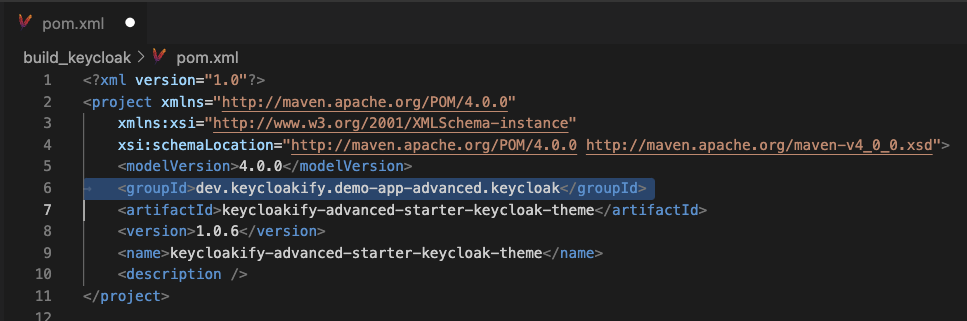
Configure the `groupId` that will appear in the `pom.xml` file.
{% code title="package.json" %}
```json
{
"keycloakify": {
"groupId": "dev.keycloakify.demo-app-advanced.keycloak"
}
}
```
{% endcode %}
By default it's the package.json hompage field at reverse with .keycloak at the end.
You can overwrite this using an environement variable:
```bash
KEYCLOAKIFY_GROUP_ID="com.your-company.your-project.keycloak" npx keycloakify
```
### keycloakify.artifactId
*Introduced in 6.11*
Configure the `artifactId` that will appear in the `pom.xml` file.
{% code title="package.json" %}
```json
{
"keycloakify": {
"artifactId": "keycloakify-advanced-starter-keycloak-theme"
}
}
```
{% endcode %}
By default it's `package.json["name"]-keycloak-theme`
You can overwrite this using an environement variable:
```bash
KEYCLOAKIFY_ARTIFACT_ID="my-cool-theme" npx keycloakify
```
{% hint style="info" %}
The `artifactId` also affects [the name of the `.jar` file](https://github.com/InseeFrLab/keycloakify/blob/9f72024c61b1b36d71a42b242c05d7ac793e049b/src/bin/keycloakify/generateJavaStackFiles.ts#L85).
{% endhint %}
### version
Configure the version that will appear in the `pom.xml` file.
By default the version that is used is the one in the package.json of your project
{% code title="package.json" %}
```json
{
"version": "1.3.4"
}
```
{% endcode %}
But you can overwrite this value using an environnement variable (*Introduced in 6.11)*:
```bash
KEYCLOAKIFY_VERSION="4.5.6" npx keycloakify
```
{% hint style="info" %}
The version also affects [the name of the `.jar` file](https://github.com/InseeFrLab/keycloakify/blob/9f72024c61b1b36d71a42b242c05d7ac793e049b/src/bin/keycloakify/generateJavaStackFiles.ts#L85).
{% endhint %}
---
# Agent Instructions
This documentation is published with GitBook. GitBook is the documentation platform designed so that both humans and AI agents can read, navigate, and reason over technical content effectively. Learn more at gitbook.com.
## Querying This Documentation
If you need additional information that is not directly available in this page, you can query the documentation by asking a question.
Perform an HTTP GET request on the following URL with the `ask` and `goal` query parameters:
```
GET https://docs.keycloakify.dev/keycloakify/v6/build-options.md?ask=&goal=
```
`ask` is the immediate question: it should be specific, self-contained, and written in natural language.
`goal` is what the user is ultimately trying to achieve, the reason they need the answer. Sharing it helps GitBook give you a better, more relevant answer. A goal is most helpful when it describes the outcome the user wants rather than restating the question. For example, with `ask=how do I create an API token`, a goal like `automate deployments from our CI pipeline` lets GitBook tailor the answer to that use case.
The response will contain a direct answer to the question and relevant excerpts and sources from the documentation.
Use this mechanism when the answer is not explicitly present in the current page, you need clarification or additional context, or you want to retrieve related documentation sections.
.png?alt=media)
.png?alt=media)