> For the complete documentation index, see [llms.txt](https://docs.keycloakify.dev/llms.txt). Markdown versions of documentation pages are available by appending `.md` to page URLs; this page is available as [Markdown](https://docs.keycloakify.dev/integration-keycloakify-in-your-codebase/vite.md).
# Vite
{% hint style="danger" %}
🚨 **WARNING: ADVANCED USERS ONLY** 🚨
If you're unsure what this section is about, **this approach is NOT for you.** Instead, follow [the Quick Start Guide and fork the starter project.](/readme.md#quick-start)
This section is **only** for developers who already have an existing project and need to integrate a Keycloak theme **within it** to reuse existing components and styles.
🔹 If you're just trying to get started with Keycloakify, **stop here**—[the starter projects](/readme.md#quick-start) provide a much simpler and recommended path.
🔹 If you proceed without fully understanding how this approach differs from the starter project, you will likely get confused about what you’re actually doing, attempt to *simplify* things, and end up hitting a roadblock.
{% endhint %}
If you have a Vite project you can integrate Keycloakify directly inside it.
**Svelte**: Although this guide uses React as an example it's also applicable for Svelte, you just need to adapt it when relevent.
Let's assume we're working with a freshly initialized Vite project.
Creating a new vite project with yarn create vite. Don't do that, use your existing project.
Our codebase before installing Keycloakify
{% hint style="info" %}
Before anything, make sure to commit all your pending changes so you can easily revert changes if need be.
{% endhint %}
Let's start by installing Keycloakify (and optionally Storybook) to our project:
{% tabs %}
{% tab title="yarn" %}
```bash
yarn add keycloakify
# Installing storybook is optional
yarn add --dev storybook @storybook/react @storybook/react-vite
```
{% endtab %}
{% tab title="pnpm" %}
```bash
pnpm add keycloakify
# Installing storybook is optional
pnpm add --dev storybook @storybook/react @storybook/react-vite
```
{% endtab %}
{% tab title="bun" %}
```bash
bun add keycloakify
# Installing storybook is optional
bun add --dev storybook @storybook/react @storybook/react-vite
```
{% endtab %}
{% tab title="npm" %}
```bash
npm install keycloakify
# Installing storybook is optional
npm install --save-dev storybook @storybook/react @storybook/react-vite
```
{% endtab %}
{% endtabs %}
Next we want to move the relevant files from [the starter template](https://github.com/keycloakify/keycloakify-starter) into our project:
```bash
cd my-react-app
git clone https://github.com/keycloakify/keycloakify-starter tmp
mv tmp/src src/keycloak-theme
# Note for the following command: If you already have Storybook setup
# in your project you can skip this.
# Only make sure you have `staticDirs: ["../public"]` in your .storybook/main.ts
mv tmp/.storybook .
rm -rf tmp
rm src/keycloak-theme/vite-env.d.ts
mv src/keycloak-theme/main.tsx src/main.tsx
```
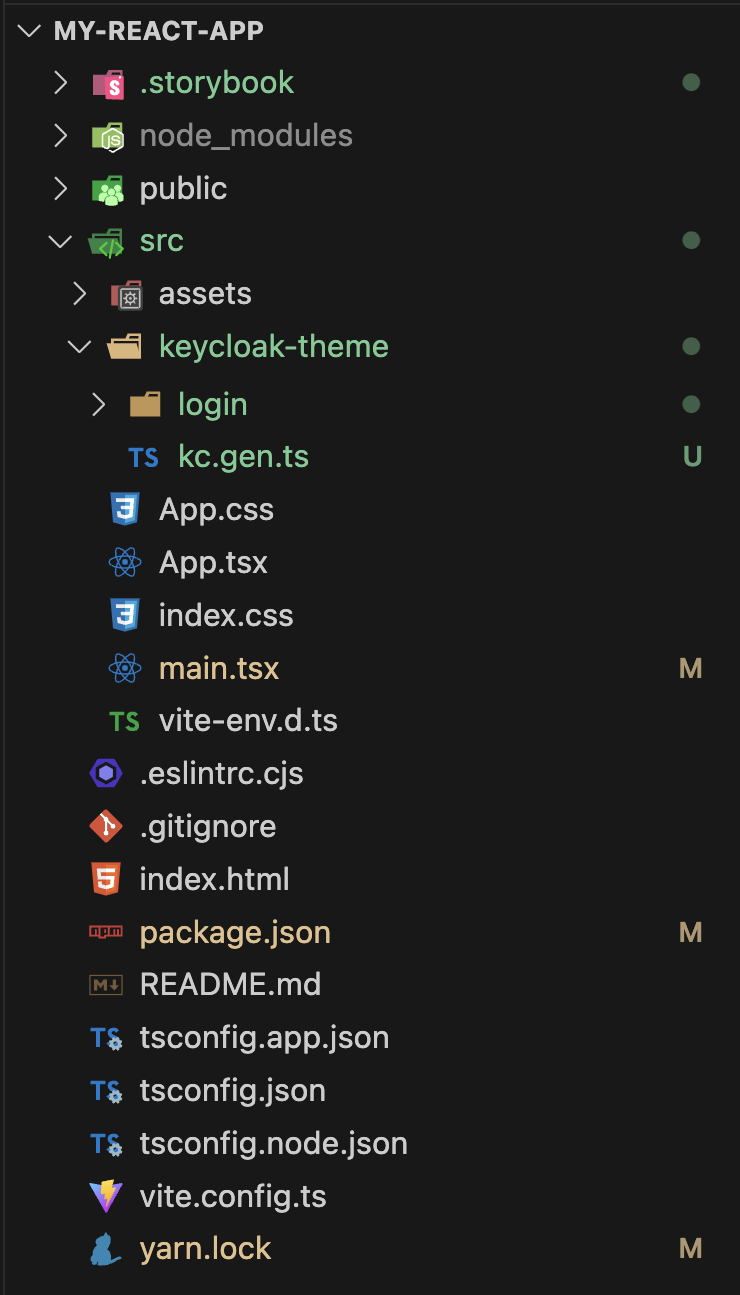
State of your codebase after bringing in the Keycloakify boilerplate code. Note thate the keycloak-theme (or keycloak_theme) directory can be located anywhere under your src directory.
Now you want to modify your entry point so that:
* If the kcContext global is defined, render your Keycloakify theme
* Else, reder your App as usual.
Let's say, for example, your **src/main.tsx** file currently looks like this:
{% code title="src/main.tsx" %}
```tsx
import { StrictMode } from "react";
import { createRoot } from "react-dom/client";
import App from "./App";
import "./index.css";
import { MyProvider } from "./MyProvider";
createRoot(document.getElementById('root')!).render(
,
);
```
{% endcode %}
You want to **rename** this file to src/main.app.tsx (for example) and modify it as follows:
{% code title="src/main.app.tsx" %}
```tsx
import App from "./App.tsx";
import "./index.css";
import { MyProvider } from "./MyProvider.tsx";
export default function AppEntrypoint() {
return (
)
}
```
{% endcode %}
{% hint style="info" %}
If you have some top level `await` and you don't know how to deal with thoses, join [the discord server](https://discord.com/invite/kYFZG7fQmn), I can help you out.
{% endhint %}
Then you want to create the following **src/main.tsx** file, you can copy and paste the following code (it does not need to be adapted):
{% code title="src/main.tsx" %}
```tsx
import { createRoot } from "react-dom/client";
import { StrictMode, lazy, Suspense } from "react";
import { KcPage, type KcContext } from "./keycloak-theme/kc.gen";
const AppEntrypoint = lazy(() => import("./main.app"));
// The following block can be uncommented to test a specific page with `yarn dev`
// Don't forget to comment back or your bundle size will increase
/*
import { getKcContextMock } from "./keycloak-theme/login/KcPageStory";
if (import.meta.env.DEV) {
window.kcContext = getKcContextMock({
pageId: "register.ftl",
overrides: {}
});
}
*/
createRoot(document.getElementById("root")!).render(
{window.kcContext ? (
) : (
)}
);
declare global {
interface Window {
kcContext?: KcContext;
}
}
```
{% endcode %}
{% hint style="info" %}
**Question:**
Why do my main application and Keycloak theme share the same entry point?
**Answer:**
To simplify the build process. If you don't want it to negatively impact the performance of your application, it's essential to understand the following points:
* **Different Contexts:** The application (`App`) and Keycloak page (`KcPage`) are mounted in very different contexts. Avoid sharing providers between the two at the `main.tsx` file level. The true entry point of your application is the `AppEntrypoint` component defined in `main.app.tsx`, while the entry point for your Keycloak theme is the `KcPage` component. Be careful about what code is shared between them.
* **Responsibility of main.tsx:** The `main.tsx` file should only determine the context (either the application or Keycloak) and mount the appropriate component (`App` or `KcPage`). It should not contain any substantial logic or dependencies.
* **Performance Considerations:** Keep `main.tsx` as lightweight as possible to avoid increasing the initial load time of both your main application and login pages. For example, do not load any state management libraries like `redux-toolkit` at this level.
{% endhint %}
You also need to use Keycloakify's Vite plugin. Here we don't provide any [build options](/features/compiler-options.md) but you probably at least want to define [keycloakVersionTargets](/features/compiler-options/keycloakversiontargets.md).
import { defineConfig } from 'vite'
import react from '@vitejs/plugin-react'
import { keycloakify } from "keycloakify/vite-plugin";

// https://vitejs.dev/config/
export default defineConfig({
  plugins: [
    react(),
    keycloakify({
        accountThemeImplementation: "none"
    })
  ],
})
{% hint style="info" %}
Leave accountThemeImplementation set to "none" for now.\
To initialize the account theme refer to [this guide](https://github.com/keycloakify/docs.keycloakify.dev/blob/v10/keycloakify-in-my-codebase/in-your-react-project/broken-reference/README.md).
{% endhint %}
Finally you want to add to your `package.json` a script for building the theme and another one to start storybook.
` things that aren't relevent in the context of Keycloak pages.
{% hint style="danger" %}
Do not blindly copy/paste, this is just an example!
You have to figure out what does and does not make sense to be in the `` of your Keycloak UI pages.
{% endhint %}
In the above example we tell Keycloakify not to include the `` because Keycloakify will set it dynamically to something like *"ACME- Login"* or *"ACME - Register"*.
We also exclude a placeholder script for injecting environnement variables at container startup.
**That's it, your project is ready to go!** :tada:
You can run `npm run build-keycloak-theme`, the JAR distribution of your Keycloak theme will be generated in `dist\_keycloak`.
You're now able to use all the Keycloakify commands (`npx keycloakify --help`) from the root of your project.
{% hint style="success" %}
If you're currently using [keycloak-js](https://www.npmjs.com/package/keycloak-js) or [react-oidc-context](https://github.com/authts/react-oidc-context) to manage user authentication in your app you might want to checkout [oidc-spa](https://www.oidc-spa.dev/), the alternative from the Keycloakify team.
If you have any issues [reach out on Discord](https://discord.gg/mJdYJSdcm4)! We're here to help!
{% endhint %}
{% content-ref url="/pages/IuA2ldFxCCAcwJXO0fiY" %}
[Testing your Theme](/testing-your-theme.md)
{% endcontent-ref %}
{% content-ref url="<https://github.com/keycloakify/docs.keycloakify.dev/blob/v11/integration-keycloakify-in-your-codebase/broken-reference/README.md>" %}
<https://github.com/keycloakify/docs.keycloakify.dev/blob/v11/integration-keycloakify-in-your-codebase/broken-reference/README.md>
{% endcontent-ref %}
---
# Agent Instructions
This documentation is published with GitBook. GitBook is the documentation platform designed so that both humans and AI agents can read, navigate, and reason over technical content effectively. Learn more at gitbook.com.
## Querying This Documentation
If you need additional information that is not directly available in this page, you can query the documentation by asking a question.
Perform an HTTP GET request on the following URL with the `ask` and `goal` query parameters:
```
GET https://docs.keycloakify.dev/integration-keycloakify-in-your-codebase/vite.md?ask=<question>&goal=<user_goal>
```
`ask` is the immediate question: it should be specific, self-contained, and written in natural language.
`goal` is what the user is ultimately trying to achieve, the reason they need the answer. Sharing it helps GitBook give you a better, more relevant answer. A goal is most helpful when it describes the outcome the user wants rather than restating the question. For example, with `ask=how do I create an API token`, a goal like `automate deployments from our CI pipeline` lets GitBook tailor the answer to that use case.
The response will contain a direct answer to the question and relevant excerpts and sources from the documentation.
Use this mechanism when the answer is not explicitly present in the current page, you need clarification or additional context, or you want to retrieve related documentation sections.
.png?alt=media)
.png?alt=media)