> For the complete documentation index, see [llms.txt](https://docs.keycloakify.dev/llms.txt). Markdown versions of documentation pages are available by appending `.md` to page URLs; this page is available as [Markdown](https://docs.keycloakify.dev/keycloakify/v10/keycloakify-in-my-codebase/as-a-subproject-of-your-monorepo/nx-integrated-monorepo.md).
# Nx Integrated Monorepo
Let's see how to integrate a Keycloakify theme into a Nx project with integrated monorepo.
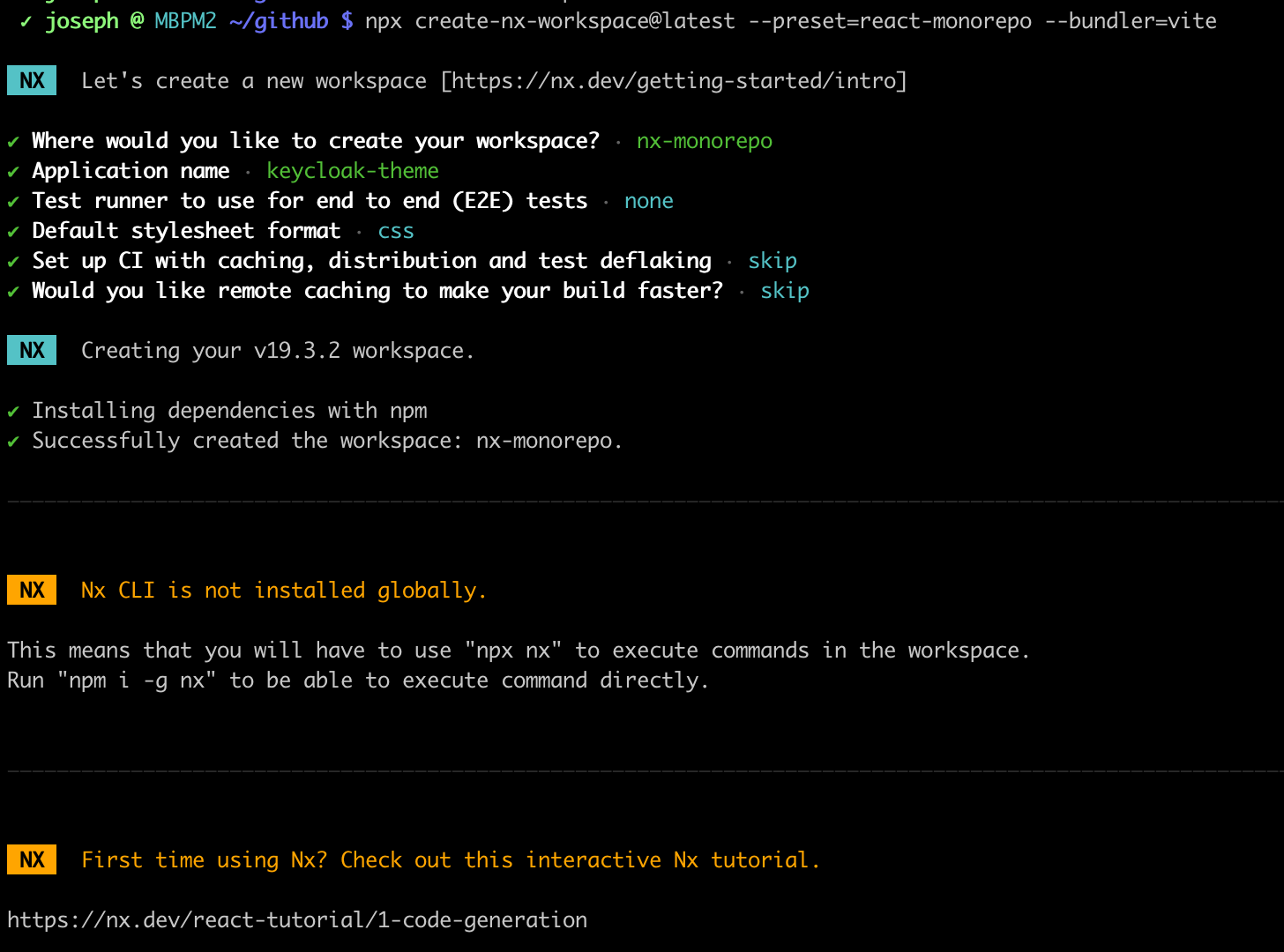
In this example we'll start with the Nx Vite starter
```bash
npx create-nx-workspace@latest --preset=react-monorepo --bundler=vite
```
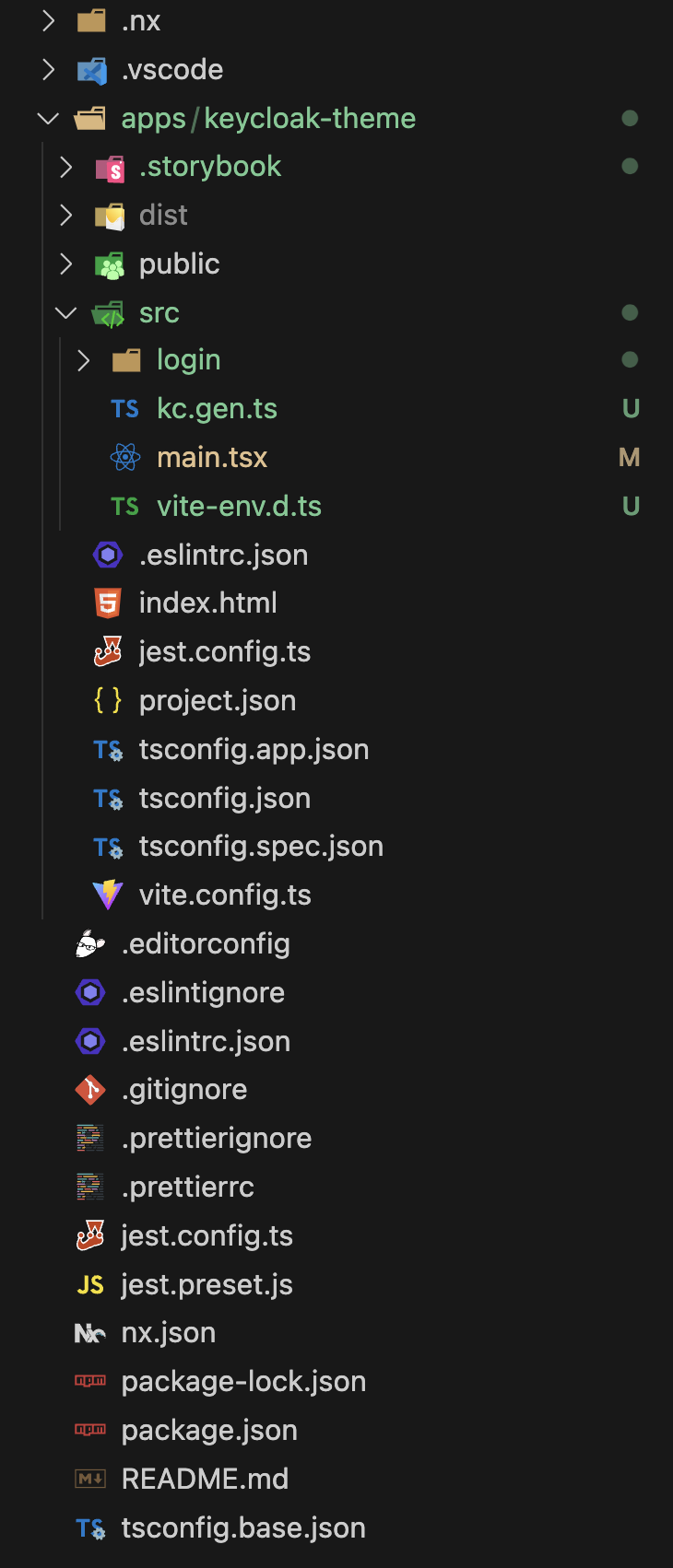
Next up we want to repatriate the Keycloakify Starter template sources.\
We only copy over the src and .storybook directory.
```bash
cd nx-monorepo
rm -rf apps/keycloak-theme/src
git clone https://github.com/keycloakify/keycloakify-starter tmp
mv tmp/src apps/keycloak-theme
mv tmp/.storybook apps/keycloak-theme
rm -rf tmp
```
After moving src and .storybook to apps/keycloak-theme
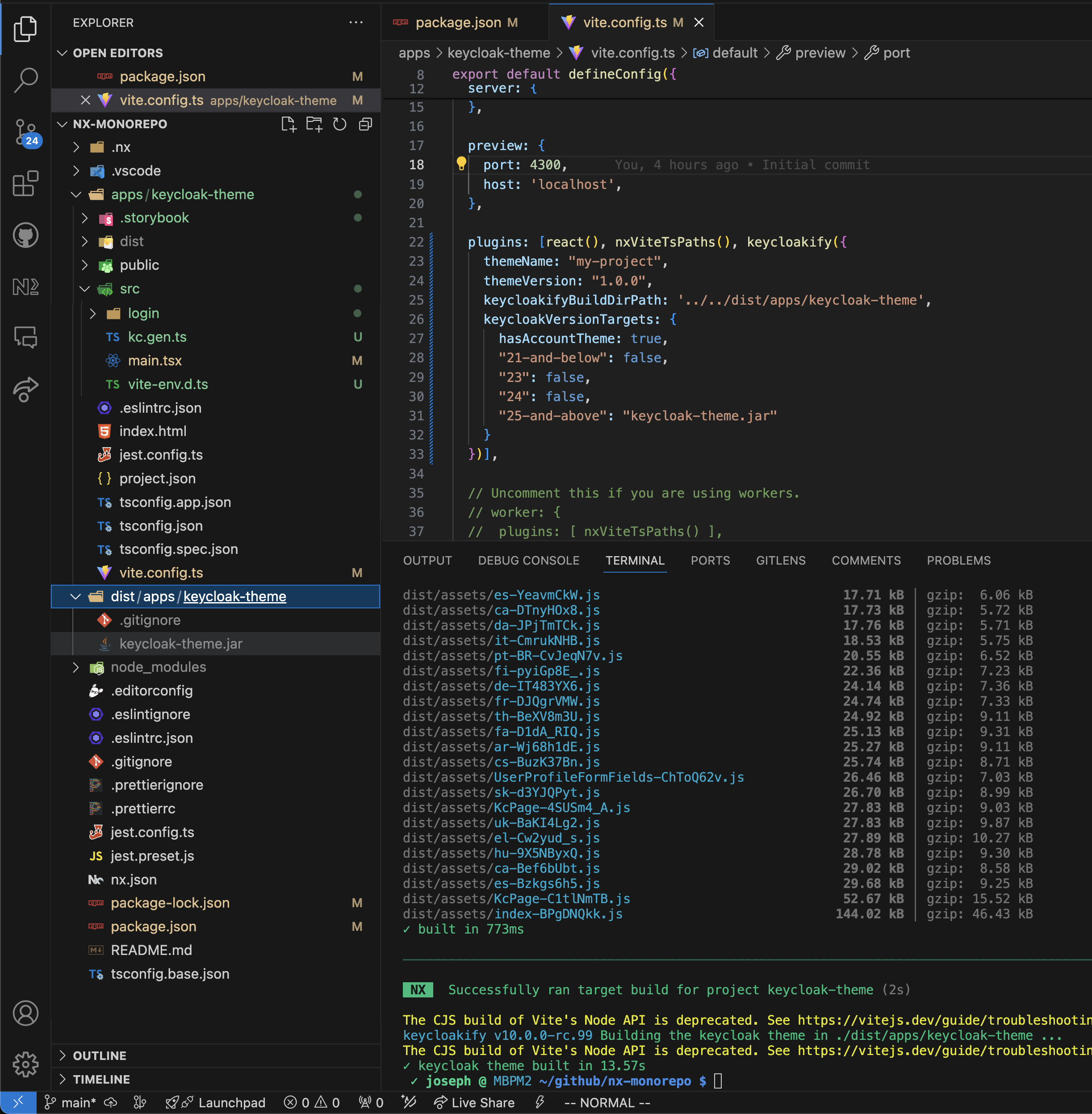
Now if you run `npm run build-keycloak-theme` it will generate the JAR in dist/apps/keycloak-theme.
When you want to use the keycloakify CLI commands you can either cd into your keycloakify sub app directory or use the [--project option of the Keycloakify CLI](/keycloakify/v10/configuration-options/project.md).\
Like for example if you want to run [add-story](/keycloakify/v10/testing-your-theme/in-storybook.md) you can do either:
* `cd apps/keycloak-theme && npx keycloakify add-story`
OR
* `npx keycloakify add-story -p apps/keycloak-theme` from the root of your monorepo
To go beyond the base configuration you might want to explore what [build options](/keycloakify/v10/configuration-options.md) are available. Starting with with `keycloakVersionTargets` to make sure that you only generates the JARs file you need.
{% content-ref url="/pages/UY54L7bRtl3LTcI1bHkN" %}
[Targetting Specific Keycloak Versions](/keycloakify/v10/targeting-specific-keycloak-versions.md)
{% endcontent-ref %}
---
# Agent Instructions
This documentation is published with GitBook. GitBook is the documentation platform designed so that both humans and AI agents can read, navigate, and reason over technical content effectively. Learn more at gitbook.com.
## Querying This Documentation
If you need additional information that is not directly available in this page, you can query the documentation by asking a question.
Perform an HTTP GET request on the following URL with the `ask` and `goal` query parameters:
```
GET https://docs.keycloakify.dev/keycloakify/v10/keycloakify-in-my-codebase/as-a-subproject-of-your-monorepo/nx-integrated-monorepo.md?ask=&goal=
```
`ask` is the immediate question: it should be specific, self-contained, and written in natural language.
`goal` is what the user is ultimately trying to achieve, the reason they need the answer. Sharing it helps GitBook give you a better, more relevant answer. A goal is most helpful when it describes the outcome the user wants rather than restating the question. For example, with `ask=how do I create an API token`, a goal like `automate deployments from our CI pipeline` lets GitBook tailor the answer to that use case.
The response will contain a direct answer to the question and relevant excerpts and sources from the documentation.
Use this mechanism when the answer is not explicitly present in the current page, you need clarification or additional context, or you want to retrieve related documentation sections.